


The Importance of Identity and Building a Multicultural Society
Brian Bwesigye
Co-Founder and Programs Manager
The Centre for African Cultural Excellence,
Kampala, Uganda
Entering a car for a first time in Nyanja, where I grew up, was a big thing to many of my agemates. They would always say, ‘ekyooma ky’omujungu’ to express their wonder at ‘the amazing technology of the whiteman’. Growing up then, in somewhat privileged circumstances compared to many of my agemates in the rural district on the border between Uganda and Rwanda, I never thought much about cars and what the whole ‘mujungu’ or racially ‘white’ ascription to them meant. The identity of a car was not something I could decipher at that age and with that level of exposure.
As they say, with more traveling and growth, I came to know more. That actually, ‘omujungu’ as an identity is itself divided into several sub-identities. That not all cars are made by one nationality of ‘omujungu’ and indeed the names of the car brands showed the differences in the identity of the makers. With time, I saw that a Suzuki was different from a Mercedes Benz, a Ford car equally different from a Tata lorry. These names came in the various languages spoken by the makers of the cars.
With more education, travel, reading and thinking, I also realized that languages are important to a people’s civilization and identity. As I asked myself more questions about the connection of cars, their brand names to ‘omujungu’ and to modernity, more and more questions arose. These questions became overwhelming in 2011, while I was studying for a Masters degree in Human Rights at Central European University, Budapest.
Why is there no African version of modernity in the mainstream study of ‘development’? Why is ‘modernity’ so limited to the ‘Enlightenment’ project, which is specific to one historical context and not the many histories of the various peoples of the earth? What are those things that bear African brand names in today’s modernity? How does the idea of an African modernity look like? How did we Africans start associating modernity with foreignness, with ‘abajungu’? If ‘modernity’ in its basic sense is derived from the word ‘modern’, which is synonymised by ‘contemporary’, ‘new’, ‘up-to-date’, ‘present’, ‘current’, ‘today’ and others, why then does the impression of modernity not include African ‘contemporariness’?
I found that the more questions I asked, the more the answers became elusive. My questions begot more questions. One finds a few facts that may give an impression of providing answers, but as one seeks to understand deeper, these answers raise more questions. In discovering the important role of literature, music, language, the arts and culture generally in the cultivation of the perceptions of the identity of modernity in Africa, fresh questions arose. So, if indeed the soft power of the works of Shakespeare, Hugo, Plato etc on our definition of modernity has lasted this long, is there no African modernity in the same sense? Is there only ‘omujungu’ modernity?
(Of course not.)
There are unique African products that I know, branded in African languages. Clothing is the easier option for example purposes. The kente cloth, kitenge, ankara, busuuti and many others are not just contemporary but are also reflective of philosophies of the people who invented them. So, indeed, African civilisations are alive. Equally, there are African books, songs, dances and other arts and aspects of culture that are born of the various African civilizations. It is important to stress that these do not exist in the past but are contemporary. More questions followed these hypotheses. So what happens with these civilizations, what happens to this African modernity? How does the toddler in Nyanja see modernity as something not unique to ‘abajungu’? How does he start seeing his own people’s outlook, their way of life as ‘modern’ enough?
These questions eventually led to the birth of the Centre for African Cultural Excellence (CACE). From the realization that we need to keep asking questions and that from asking questions, we will keep arriving at more questions, more refined but never the ultimate answer. But nevertheless in asking, the fresh questions we ask of our world create the answers for the future world. CACE as an organization was born of the need for expanding the visibility and recognition of African modernity to Africans themselves. CACE puts value on the immense power in the softness of the arts and culture in shaping presents and futures. There is power in a satirical story about individuals living in specific spaces with subtle but deeply influential nuances that shapes a reader’s worldview. In speaking a language, the speaker espouses the ideals of the people who made the language.
CACE as an organization took shape in 2012 when I met Ms. Naseemah Mohamed, then a student at Harvard at a Harambe Bretton Woods Symposium. Naseemah’s belief in the power of the arts and culture in breaking down the ineffective colonial approach to education in postcolonial societies was at many levels within the purview of my own vision for CACE. It was natural for us to join hands. At this stage, I had also agreed with my brother from Nyoro royal roots, Mr. Kyomuhendo Ateenyi that our long conversations about African identity, African arts and culture should become more tangible, and reach out to others outside of our narrow networks.
CACE inherited the hardwork of us the three. Naseemah’s Zilolonge Arts Literacy project, which she had already implemented as her Social Engagement course at Harvard provided a foundation for the organisation to build on. In October 2012, CACE launched its first major project dubbed Writivism. Writivism seeks to engage young writers and readers in societal discourse through the medium of short fiction. The project, supported from its birth by the Global Changemakers program of British Council attracted 43 short story entries on the themes of Diversity, Equality and Identity.
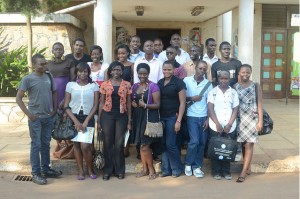
Though the project is still unfolding, we held a writing workshop in January 2013, led by South African writer Zukiswa Wanner and Ugandan writer Beatrice Lamwaka. The longlisted writers were mentored by Nigerian writers Ukamaka Olisakwe Evelyn, Emmanuel Iduma, Richard Ali, Abubakar Adam Ibrahim and Dami Ajayi for close to three months. The longlisted stories are being published online at Short Story Day Africa, Readers Cafe Africa among other places and in the newspapers notably The Observer. An anthology comprising the fourteen stories was published on 21 June 2013.
The writers are touring selected schools in Uganda, they will hold public readings and from 15 – 19, the project year will end with The Writivism Festival in Kampala. As with all ideas, adherents to an unified vision are never in lack. We have since merged with Short Story Day Africa and are open to collaborations and expansion of our program as we begin planning next year’s Writivism festival. We are looking forward to eventually engaging more young people, from South Africa to Nigeria.
Aside from our Writivism project, CACE is building a small community of multilingualism enthusiasts through A Dialogue of Tongues (ADOT) events. A typical ADOT event brings together up to twenty young people who speak different African languages to linguistically teach and learn from one another. The participants are therefore introduced to a new language which they learn over a period of one year with the help of their peers. We also hold Book Talk events on a monthly basis, where we bring together several young people to discuss topical ideas in African authored books. We use these discussions to engage the participants in quality African literature, and more importantly to draw out contemporary themes that could possibly give, albeit subjective, answers to the questions of African modernity, ethics and social and economic growth. Because CACE believes that literary scholarship is a powerful tool for intellectual and social growth, we are running a six-week Freelance Writing Course in Uganda since July 2013 for aspiring writers and journalists.
As an organization, we believe that these small projects will empower African youths to begin to question what their respective national and continental identity means, and what ‘African modernity’ looks like to Africans. Ultimately CACE is built on the belief in a culturally driven world. We want to see a world that has space for all civilizations, a modernity that does not exclude but includes all, and acknowledges the strength and diversity of each person, village, city and country. Through each young person we engage in our projects, through every update on our Facebook page, we believe that we are taking a small but crucial step to build a literate, civically engaged and ultimately a questioning society.