
To Harnessing soil and water resources for increased rice productivity in Africa
by Christopher Oluwakunmi Akinbile
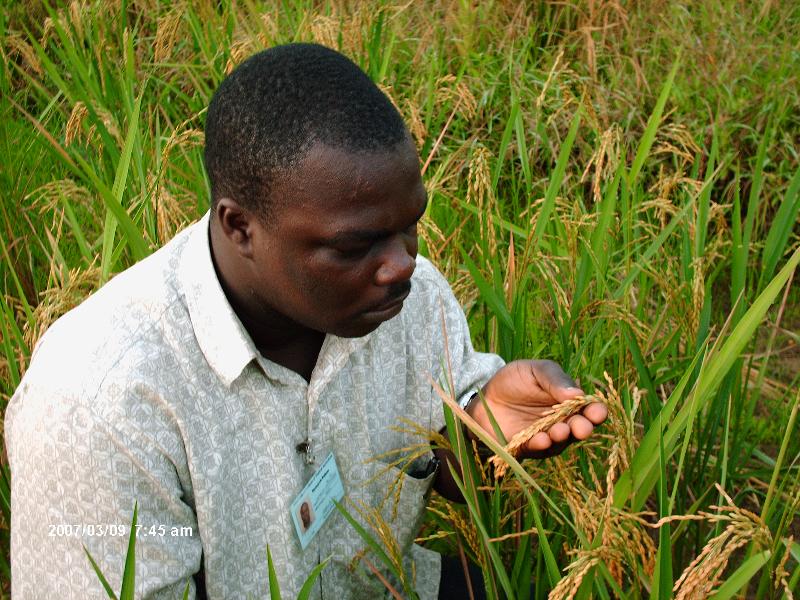
The article talks about harnessing soil and water resources for ensuring increase in food (rice) productivity in order to attain self-sufficiency. The choice of rice is due to its strategic importance to Nigeria and the huge amount of money being used for its importation when adequate land and water resources are available for its production at self-sufficiency levels.
Food Security in Kenya: Rice Research Agenda
by Kimani Munji
The article talks rice being posed to play a key role in Kenya, in providing or meeting food and nutritional needs of her people. However, there are challenges to be overcome; among them, land degradation, growing population, climate change and variability, expanding consumption. All these have contributed to huge rice imports despite the fact that Kenya has the capacity to produce enough for her domestic consumption and even export to the region and overseas markets.
Key players that are working in tandem to ensure food and nutritional security is secured are: the Rice Promotion Unit (RIPU) a brainchild of Japan International Cooperation Agency (JICA), World Bank, East Africa Agricultural Productivity Project (EAAPP) covering Tanzania, Uganda, Ethiopia and Kenya, Alliance for a Green Revolution in Africa (AGRA), International Rice Research Institute (IRRI), Africa Rice Centre (ARC), International Cooperation Center for Agricultural Education (ICCAE), Kenya Seed Company, Vibha Seed (Ke) limited, and other regional Institutions like ASARECA, and National Agricultural Research Systems like Kenya Agricultural Research Institute (KARI).
Read the article (.pdf)Which future we want: An Assessment of the Rio+20
by Oswaldo Lucon
The article talks about the long expectation to the United Nations Conference on Sustainable Development – the so-called Rio+20. Preparatory negotiations had a sense of a real dialogue and willingness to find common ground. Few key deliverables would make a difference: defining sustainable development goals (SDGs) as a central feature of a post-2015 development framework, exploring green economy policy options to advance sustainable development and eradicate poverty, and to make decisions on key elements of the international institutions needed to support such governance. There was a vast array of topics to be addressed under such umbrella: food security and sustainable agriculture, energy, oceans, gender equality and women’s empowerment, and education.
The necessary means of implementing action were on the table, including initiatives to strengthen financing, technology transfer and capacity building. UN Secretary-General Ban Ki-moon urged as a priority for a new model that offers growth and social inclusion, also more respectful of the planet’s finite resources.
Stakeholders were encouraged to make and implement voluntary commitments at Rio+20 in order to get to what the main document stated in its title: The future we want.
Read the article (.pdf)Investing in Water Security for Climate Resilient Growth and Development
by Alex Simalabwi
Water is a key input to economic growth sectors and contributes to employment, job creation and gross domestic product (GDP). Water is at the heart of development objectives across most sectors – for example health, energy, agriculture, environment, mining, industry and social protection. Yet,
most African countries are far from achieving water security and the onset of climate change will further compromise prospects. Ensuring water security through more effective water management contributes to development goals, climate change adaptation and disaster risk reduction.
Recommendations of the report are:
- Governments should protect their development goals and ambitions against derailment by water and climate impacts.
- High-level advisors and decision makers are encouraged to increase the priority of water security and climate resilient growth and development.
They are further encouraged to benefit from, and mandate the use of, the Framework in support of the following objectives:
- To identify and develop no/low regrets investments, and to prioritise these in existing development planning, budgeting and financing processes.
- To influence existing and future development planning activities so they become more resilient to climate change and variability.
- To increase domestic and external investment in water security and climate resilient development.
- To identify innovative financing strategies for investments, exploiting opportunities from funds offering finance for climate adaptation in combination with conventional sources.