
Using Agriculture and Agribusiness to bring about Industrialization in Africa
2017 52nd AfDB Annual Meetings opinion piece
Dr. Akinwumi A. Adesina
President, Africa Development Bank


No region of the world has ever moved to industrialized economy status without a transformation of the agricultural sector. Agriculture, which contributes 16.2% of the GDP of Africa, and gives some form of employment to over 60% of the population, holds the key to accelerated growth, diversification and job creation for African economies.
But the performance of the sector has historically been low. Cereal yields are significantly below the global average. Modern farm inputs, including improved seeds, mechanisation and irrigation, are severely limited.
In the past, agriculture was seen as the domain of the humanitarian development sector, as a way to manage poverty. It was not seen as a business sector for wealth creation. Yet Africa has huge potential in agriculture – and with it huge investment potential. Some 65% of all the uncultivated arable land left in the world lies in Africa. When Africa manages to feed itself, as – within a generation – it will, it will also be able to to feed the 9 billion people who will inhabit the planet in 2050.
However, Africa is wasting vast amounts of money and resources by underrating its agriculture sector. For example, it spends $35 billion in foreign currency annually importing food, a figure that is set to rise to over $100 billion per year by 2030.
In so doing, Africa is choking its own economic future. It is importing the food that it should be growing itself. It isexporting, often to developed countries,thejobs it needs to keep and nurture. It also has to pay inflated prices resulting from global commodity supply fluctuations.
The food and agribusiness sector is projected to grow from $330 billion today to $1 trillion by 2030, and remember that there will also be 2 billion people looking for food and clothing. African enterprises and investors need to convert this opportunity and unlock this potential for Africa and Africans.
Africa must start by treating agriculture as a business. It must learn fast from experiences elsewhere, for example in south east Asia, where agriculture has been the foundation for fast-paced economic growth, built on a strong food processing and agro-industrial manufacturing base.
This is the transformation formula: agriculture allied with industry, manufacturing and processing capability equals strong and sustainable economic development, which creates wealth throughout the economy.
Africa must not miss opportunities for such linkages whenever and wherever they occur. We must reduce food system losses all along the food chain, from the farm, storage, transport, processing and retail marketing.
To drive agro-industrialization, we must be able to finance the sector. Doing so will help unlock the potential of agriculture as a business on the continent. Under its Feed Africa strategy, the African Development Bank will invest $24 billion in agriculture and agribusiness over the next ten years. This is a 400% increase in financing, from the current levels of $600 million per year.
A key component will be providing $700 million to a flagship program known as “Technologies for African Agricultural Transformation” for the scaling up of agricultural technologies to reach millions of farmers in Africa in the next ten years.
Finance and farming have not always been easy partners in Africa. Another pillar of the Bank’s strategy is to accelerate commercial financing for agriculture. Despite its importance, the agriculture sector receives less than 3% of the overall industry financing provided by the banking sector.
Risk sharing instruments may resolve this, by sharing the risk of lending by commercial banks to the agriculture sector.Development finance institutions and multilateral development banks should be setting up national risk-sharing facilities in every African country to leverage agricultural finance. And the African Development Bank is setting the pace based on a very successful risk sharing scheme that I promoted while Agriculture Minister in Nigeria.
Rural infrastructure development is critical for the transformation of the agriculture sector, including electricity, water, roads and rail to transport finished agricultural and processed foods.
The lack of this infrastructure drives up the cost of doing business and has discouraged food manufacturing companies from getting established in rural areas. Governments should provide fiscal and infrastructure incentives for food manufacturing companies to move into rural areas, closer to zones of production than consumption.
This can be achieved by developing agro-industrial zones and staple crop processing zones in rural areas. These zones, supported with consolidated infrastructure, including roads, water, electricity and perhaps suitable accommodation, will drive down the cost of doing business for private food and agribusiness firms.
They will create new markets for farmers, boosting economic opportunities in rural areas, stimulating jobs and attracting higher domestic and foreign investments into the rural areas. This will drive down the cost of doing business, as well as significantly reduce the high level of African post-harvest losses. As agricultural income rises, neglected rural areas will become zones of economic prosperity.
Our goal is simple: to support massive agro-industrial development all across Africa. When that happens, Africa will have taken its rightful place as a global powerhouse in food production. It could well also be feeding the world. At this point the economic transformation that we are all working for will be complete.
Dr Akinwumi Adesina is President of the African Development Bank.
The 2017 AfDB Annual Meetings in Ahmedabad, India, 22-26 May, will focus on ‘Transforming agriculture for wealth creation in Africa’.
Swaroshish Goswami
I am a 19 year old sophomore from Toronto, Canada studying at the University of Toronto. I am an award winning serial tech entrepreneur and innovator, UN Youth Ambassador, Huffington Post contributor, early stage tech investor, LinkedIn campus editor, social media personality and TEDx speaker.
I am one of the world’s youngest venture capitalist as a Business Development Associate at JB Fitzgerald Venture Capital. In my role, I have consulted with Fortune 500 companies on promoting investments in the digital media space. I am also the brand manager for business leaders and public figures like Trevor Booker of the Brooklyn Nets. I am currently planning on working in New York this summer and focusing my energy on writing a book on personal branding and growing my wearable tech startup Technotronics (in partnership with NBA teams like the Brooklyn Nets and Utah Jazz), RafikiMedia, The Next Foundry, and FoodShare. I have “already made a dent on the global entrepreneurial landscape” and have been notably featured on The Huffington Post, Canadian Student Business Review, and Influencive along with notably winning Startup Canada’s Young Entrepreneur of the Year award, Strategy Magazine’s Social Innovator of the Year, the United Nation’s Outstanding Youth Leadership Award, and Plan Canada’s Top 20 under 20 award. In 2016, I was recognized as the “Face and Future of Canadian Entrepreneurship” by UPS Canada.
“Nanostructured Interfaces for Therapeutic Delivery”
Prof. Tejal A. Desai,
Chair of the Bioengineering & Therapeutic Sciences Department,University of California, San Francisco, USA
“Nanostructured Interfaces for Therapeutic Delivery”
Abstract: Efficient drug delivery remains an important challenge in medicine. Continuous release of therapeutic agents over extended time periods; local delivery to overcome systemic toxicity; penetration through biologic barriers, and increasing patient compliance are some of the unmet needs of present drug delivery technology. This talk will discuss in vivo drug delivery strategies that capitalize on the strengths of micro and nanofabrication. By taking advantage of our ability to control topography and chemistry at submicron size scales, we have developed organic and inorganic interfaces which modulate cell function while at the same time allow for enhanced therapeutic delivery. Examples include nanostructured microdevices for mucosal delivery, nanotubular architectures for vascular stent applications, and nanoporous thin films for ocular drug delivery. Such nanoengineered interfaces may be optimized for biomolecular selectivity and surface bioactivity, leading to unique interfacial properties not achieved through existing drug delivery approaches.
It was the summer after my sophomore year of high school when I instantly knew what I wanted to be when I grew up. Participating in an NSF summer program for girls interested in science and engineering, I listened intently when a woman engineer came to talk to our group about what she worked on every day. But, to my surprise, it wasn’t about building bridges, circuits, or chemical reactors– it was about designing orthopedic implants for those who had lost the ability to regenerate or heal bone. She described the interplay of the materials she was designing with the biology of our bodies. The thought of being able to invent new devices and materials to help others suddenly resonated with my interest in not only doing science but also contributing to society in a meaningful way.

This new field was biomedical or bioengineering. It was an emerging discipline that sought to integrate engineering concepts and methodologies with biology. I embraced the unchartered scientific frontier and became determined to learn as much as I could.
There were times when I felt discouraged because I didn’t believe I was good enough. Not good enough to be an engineer or do scientific research. There were some professors who thought I would be better off in a different field. But, there were also those individuals (my family included) who encouraged me to persevere.
When I thought of all the people who could be helped by new discoveries, I became even more excited. I worked alongside other diligent students who made the work seem rewarding and fun.
After earning my PhD at UCSF and UC Berkeley, I started my career as an assistant professor of bioengineering in the Midwest. It was a whirlwind of new challenges – setting up a lab from scratch, mentoring students, designing and teaching new courses, and writing grants to get funding for my ideas.
Eventually, I began to receive recognition for my work, and gained the confidence to take risks and push new boundaries in my science. I now direct the Therapeutic Microtechnology and Nanotechnology Laboratory here at The University of California San Francisco (UCSF). My research focuses on micro and nanofabrication techniques to create new devices for drug and cell delivery as well as biomaterials for cell and tissue regeneration.
Currently, as the Chair of the Bioengineering & Therapeutic Sciences Department at UCSF, I have the great privilege of mentoring and supporting others. I have advised many post-docs and PhD students who have gone on to successful academic and industry positions. Of course, I still love brainstorming about new ideas and approaches to create therapies that will help people. I also write science articles for professional journals; so far, I have authored over 200 peer reviewed articles.
My work developing innovative drug delivery devices has garnered several academic and industry awards. Recently, I was deeply honored to be inducted into The National Academy of Medicine.
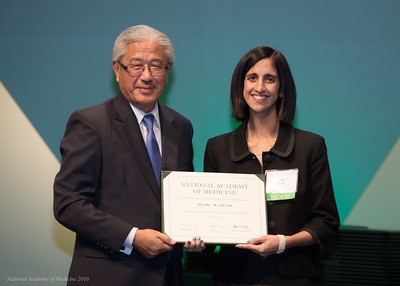
Receiving Fellowship @ NAM
One of the most interesting projects I am working on is addressing the challenges of the epithelial barrier. The epithelial barrier presents a significant obstacle to the delivery of macromolecules in the size range of 20 – 150 kDa, including a number of therapeutics. In particular, the tight junctional complex, which links adjacent cells and occludes the paracellular space, is responsible for maintaining
this barrier. To improve the transport of drugs across epithelia, new approaches need to be developed that enhance paracellular drug transport by specifically and reversibly modulating tight junctions.
My colleagues and I are investigating the effect of nanostructured surfaces on the modulation of tight junction permeability and transport of key therapeutic molecules in vitro. It is expected that the fundamental knowledge gained in these studies will enhance the development of new epithelial drug delivery systems.
The public health relevance of this work is that therapeutic macromolecular drugs currently under development are typically administered through IV injection due to their poor epithelial permeability. If we can figure out how to alter drug permeability across the epithelium in a safe and reversible manner, we can develop new delivery systems that will be less invasive and more efficacious. It may seem as though my work is all-consuming. But I assure you that you can lead a balanced and happy life.
Being a scientist does not mean you can’t have fun outside of the lab. My husband, my 3 children, and I enjoy the many wonderful recreational activities available both here in San Francisco, and
in California-at-large. We also love to travel and explore the world together. Our last adventure together was a trip to Cambodia, Singapore and Hong Kong.
I hope I will see you somewhere along the path!
Dr. Tejal Desai

Dr. Tejal Desai is currently Professor of Bioengineering and Therapeutic Sciences at the University of California, San Francisco. She is also Chair of the UCSF/UC Berkeley Graduate Group in Bioengineering, Director of the UCSF/UC Berkeley Translational Medicine Program (MTM), and a member of the California Institute for Quantitative Biomedical Research. Dr.Tejal Desai directs the Laboratory of Therapeutic Micro and Nanotechnology at UCSF.
Her research uses micro and nanofabrication techniques to create implantable biohybrid devices for cell encapsulation, drug delivery, and templates for cell and tissue regeneration. In addition to
authoring over 150 technical papers and delivering over 150 invited talks, she is the co-editor of an encyclopedia on Therapeutic Microtechnolog and a senior editor of Langmuir and Biomedical
Microdevices.
Desai’s research efforts have earned her numerous awards. She has been cited by Technology Review Magazine as one of the nation’s “Top 100 Young Innovators”, received the Global Indus Technovator Award, and named as Popular Science’s Brilliant 10. Desai’s teaching efforts were recognized when she won the College of Engineering Best Advisor/Teacher Award. She also
won the National Science Foundation’s “New Century Scholar” award and the NSF “CAREER” award, which recognizes teacher-scholars most likely to become the academic leaders of the
21st century.
Her research has also earned her the Visionary Science Award from the International Society of BioMEMS and Nanotechnology, the 2003 and 2006 Eurand Grand Prize Award for innovative drug delivery technology, the 2007 Young Career Award from the Engineering in Medicine and Biology Society (IEEE EMBS) and the UC Berkeley Distinguished Young Alumni award.
How ENVenture is bringing 21st century business skills to rural non-profits
Mukhobeh MosesKhaukha is the Executive Director of Hands of Action Uganda, a not-for-profit registered Community Based Organization working in to improve the lives in Bududa district. This region of Uganda is regularly affected by tragic mud slides, which has plagued the economic development of his community. Moses decided to first improve his community by building a school, in which thousands of children are enrolled. Hands of Action even invented an innovative educational practice for teachers to shout,” gender balance!” when girls were not participating as much as boys in the classroom. However, though Moses was able to tackle child education, he also knew of the systemic problem of lack of electricity, modern fuels for cooking, and clean water in his community; problems that he did not know how to fix.
Aneri Pradhan (néePatel), the Executive Director of ENVenture, a social enterprise that coachesrural community based organizations to start clean energy businesses, was struck by Moses’s passion and enthusiasm for helping Bududa. She visited Hands of Action with Jane Muganga who runs Friends of Family Organization, another CBO who has benefitted from ENVenture’s program. It was decided; FOFO would use ENVenture’s loan to pay forward to Hands of Action for them to start their own clean energy business.
Although the funding piece was solved, there was still the question of starting a clean energy business. After all, Moses was not familiar with clean energy technologies and he did not know where to start. Stepping up to the challenge was ENVenture’s Business Development Fellow Bettina Bergoo, a young professional from the US with a degreein Environmental Studies from Georgetown University. Upon arriving in Bududa, the first thing she noticed is that her own house did not have electricity or running water.
She worked with a provider that brought solar to her roof and she installed a rain water harvesting system. Her home quickly became a mobile charging station for the community! Next,she worked with the provider to install solar on top of the school. Now the schoolchildren could have access to electricity while learning. Embedded in the community, she performed market research, understood financial behaviors of potential customers, and developed a business plan with Moses’s team. They decided to call their venture Mt. Elgon Clean Energy.
Currently Mt. Elgon Clean Energy has sold thousands of dollars’ worth of clean energy products, is profitable, and is on track to expand with further outside investment. For a community where people earn less than $2 a day, this is an impressive amount of growth. ENVenture has eight CBO partners across Uganda with plans to scale to two-hundred, thereby creating a community of practice to share lessons, supplier contacts, and other useful information between each other.
ENVenture firmly believes in the power of local communities to be able to solve their own problems in the communities; these communities simply need a hand-up, not a hand-out.
ENVenture is a 501(c)(3) US non-profit with operations in Uganda. If you are interested in applying for their Business Development Fellowship, please visit www.enventureenterprises.org.
This article is written by Aneri Pradhan, the Founder and Executive Director of ENVenture. You can follow her at @_ENVenture.
Dr. Anindita Bhadra
 Dr. Bhadra is a behavioural biologist, working with free-ranging (stray) dogs in India. While pet dogs are studied extensively and compared with wolves in order to understand the evolution of the dog-human relationship, free-ranging dogs in India provide the perfect model system for studying them in nature, and building an understanding of the intrinsic nature of dogs. As they have hardly been studied so far, Dr. Bhadra chose the dogs as a model system, shifting completely from her zone of training and comfort, social insects. This gave her the freedom to set up a research group from scratch, doing things that she had never done before, and exploring new vistas of research.
Dr. Bhadra was involved in the founding of INYAS, and was elected as the first Chairperson by the founding members in June 2015.
Key Insights in The Rise And Fall of Nations
KEY INSIGHTS | ORIGINAL RESEARCH
From
THE RISE AND FALL OF NATIONS |
RUCHIR SHARMA
The Four D’s
The world economy is fighting the friction generated by 4D’s. Deglobalization: international trade is now growing slower than the global economy for the first time in a generation, and cross border money flows have retreated to levels last seen a quarter century ago. Depopulation: since 2005, the working age population of the world has been growing at just 1 percent a year, half the rate of the previous 50 years. Deleveraging: the world has racked up $50 trillion in debt since 2008, more than it did in the years before the crisis and mainly driven by China, and only parts of the developed world have begun paying down the debt or “deleveraging”. De-democratization: many governments are trying to force feed the economy into growing faster, and 110 countries—more than half—have suffered some loss of freedom in the last 10 years.
The Age of Pessimism
The forces weighing on the global economy are real, but this is not an excuse to embrace fashionable pessimism. As economist Joseph Schumpeter warned, “pessimistic visions about anything usually strike the public as more erudite than optimistic ones.” It’s time to rethink success and every nation needs to downscale its ambitions. The fastest-growing economies are almost always the poorest ones, but even they need to be more realistic. In India’s income class, the definition of strong growth should come down from better than 7 percent to better than 5 percent, a standard that will reveal surprising success stories. For rich nations, the benchmark should come down from about 3 percent to 1.5 percent, which would help ease the gloom in the United States and Europe.
The Good, the Average and the Ugly
I use a system of 10 rules to rank theprospects of the world’s leading nations as “good, average or ugly,” an approach with a simple beauty. Even in pessimistic times, the rules will always reveal which nations are bestin class. Right now, the rules shows that China has among the ugliest prospects in the emerging world, in part because no other country is getting hit harder by the forces of depopulation, debt, and the deglobalization of trade and money flows. Yet the rules also reveal pockets of strength in economies that are far off the media radar, from the Philippines to Kenya, Bangladesh and Pakistan.
The Depopulation Bomb
It’s half the global slowdown story. Economic growth is broadly driven by populationplus productivity: more workers producing more output per hour. So if population growth slows, so does the economy, and global population growth has fallen by nearly half in the last decade, compared to its postwar average. My research shows that if a nation’s working age population is growing at less than 2 percent a year, then its economy will grow rapidly—faster than 6 percent a year—in just one out of four cases. In the 1980s, 17 of the largest 20 developing countries had a population growth rate that fast and now there are only two: Saudi Arabia and Nigeria. That means the world should expect fewer economic miracles in the years ahead. India falls into the next tier, with a working age population growth rate that is expected to average 1.5 percent over the next five years. That’s reasonably fast, but not in the miracle class.
Good Versus Bad Billionaires
Wealth inequality is exploding, provoking political revolts from South Korea to the United States. To track which countries are most vulnerable to these revolts, I use the yearly Forbes list to track the wealth of billionaires, the high-profile lightning rods for social unrest. First I calculate billionaire wealth as a share of GDP, to get a picture of their hold over the economy. Then I figure out how much of their wealth comes from inherited fortunes and corruption-prone industries like real estate or oil, which reveals the power of the “bad billionaires.” It is the rise of shady characters in these rent-seeking industries that is most likely to stir popular anger. I first started tracking billionaires in India around 2010, when the rise of crony capitalists was stirring a backlash against capitalism itself. Today billionaire wealth represents 14 percent of GDP, still well above the global average, but the bad billionaires are in retreat. Between 2010 and 2015 India saw one of the world’ssharpest gains in the clout of good billionaires, in industries like technology and pharmaceuticals: they saw their totalfortunes rise by 22 percentage points to 53 percent of total billionairewealth. These trends may have taken the edge off the anticorporate, antigrowthsentiment that gripped Delhi over the priordecade.
The Curse of the Cover Story
American journalists have a joke about the backward-looking nature of their profession,which is that by the time a story reaches the cover of Time, it’s already dead. To test for truth in this jest, I looked at every Time cover with an economic spin on a country or region, going back to 1980. If the cover was downbeat, the economy subsequently picked up speed 55 percent of the time. If the cover was upbeat, the economy slowed down 66 percent of the time. The curse of the cover is real. The point is not to disparage journalists, but to highlight the fact that they tend to follow mainstream forecasters, who typically predict that economies will keep moving in a straight line, and miss the big turning points. That explains why Time would ask whether this is “China’s Century, or India’s” in November 2011, the year when all the big emerging economies started to slow sharply. (Interestingly, the same test for The Economist magazine showed that, perhaps thanks to its contrarian worldview, its covers proved prescient more than half the time.) To avoid the curse, countries basking in the glow of media hype should start worrying and looking for ways to reform.
The Fall of The Rest
In 2010 many emerging nations were growing so fast, their average incomes were rapidly catching up to those of the United States. Hype for “the rise of the rest” hit a peak, which signaled a turn in the story. By last year, the average growth rate in emerging nations had fallen from a high of around 8 percent in 2010 to its long term average of 4 percent, and 2 percent excluding China. The United States was expanding faster than many of the big emerging countries, from Russia and Brazil to South Africa, where average incomes were in decline. This is perfectly normal. My research shows that in every decade before 2000, going back to 1960, the average income of most emerging nations fell relative to the United States. In Brazil, incomes rise and fall with prices for its major commodity exports, and the average income is the same, relative to US incomes, as it was a hundred years ago.
Why Democracies Outrun Authoritarian Regimes In The Long Haul
The rise of China convinced many people that autocracies have an advantage in generating strong economic growth. To test that faith, I looked at all the postwar booms and found 60 in authoritarian countriesand 64 in democratic countries. Moreover, authoritarian regimes are much more likely to grow in extremely fast or slow spurts, with wild swings between the two extremes. Since 1950, there have been 138 cases in which a country grew very slowly for a decade, and 100 of those slumps struck under an authoritarian government. The worst boom-bust swings came under notorious dictators like the Assad’s of Syria, but a similar authoritarian roller coaster effect has disrupted nations like Brazil in the late 1960s. In the post crisis era, pockets of people in many troubled nations, from Russia to India,have looked to a strong hand to restore prosperity, but they should beware what they wish for. China’s steady economic success under authoritarian rule story was the exception, not the rule.
The Point of No Return
Though many economistshave looked for it, and some claim to have found it, there is no holy grail, no one key that foretells a nation’s future. The single most reliable indicator I have found is a negative one, which signals a warning when the debts of private households and companies has grown more than 40 percentage points faster than GDP over a five-year period. Over the past 50 years, every nation that passed that point of no returnwent on to suffer a serious economic slowdown. In recent years, many emerging nations have been rapidly running up debts, while the private sector in the United States and other wealthy countries were cutting back. This is a complete reversal of the state of the world before 2008. But only one emerging country has passed the point of no return: China. India, by contrast, is suffering from the opposite problem: one of the biggest obstacles to faster growth is anemic credit growth, due to a sclerotic system in which state banks control 75 percent of all loans, more than double the emerging world average.
The Second City Rule
For large countries, I track the geographic balance of economic growth by monitoring the rise of second cities, with populations of more than a million. In the small class of mega-nations, China is beating India hands down. China has nineteen cities that have quadrupled in size over the last three decades to more than a million people, compared to just two in India. China’s include the southern industrial boomtowns of Dongguan and Shenzhen, with more than 7 million. India’s areMallapuram andKollam in Kerala state, with barely over a million, and they passed that mark due largely to a redrawingof the local administrative map in 2011.
Of course, one reason for China’s lead is that its economy has grownmuch faster than India’s, and industrialization encourages urbanization.But even with that caveat in mind, India has also done less todevelop and much to discourage the rise of second cities, reserving prime urban real estate for civil servant enclaves like Lutyens Delhi, and cramping development with outdated building and zoning codes. Smaller cities struggle to grow, andwhen rural Indians do move to urban areas, they tend to choose themegacities with more than ten million people: Mumbai, Delhi,Kolkata, and Bangalore. In fact 17 percent of India’s population lives in such megacities, compared to 12 percent of China’s. If China is developing as a nation of boom cities, India is aland of creaking megacities, surrounded by small towns and not enoughvibrant second cities.
The Curse of The Second Term
Economic reform is most likely under bold new leaders, but even the best reformers grow stale and start to run out of ideas, the popularity to implement them, or both. The markets sense this process of decay, and tend to turn on leaders over time. Over the past 25 years in the major emerging democracies sixteen presidents and prime ministers have lasted two or more terms in office, including Vladimir Putin of Russia and Manmohan Singh. The stock markets in these countries beat the emerging world average by 16 percent in the leaders’ first terms, but delivered just average returns in the second terms. This is strong confirmation of what is known in the United States as “the curse” of the second term, since many of these leaders started out as economic reformers but lost momentum in their second term.Some of the weakest second term results came under RecepTayyip Erdogan in Turkey,where the stock market lagged behind the emerging-world averageby 18 percent during his second term, from 2007 to 2011; and Singh in India, which lagged by 6 percent during hissecond term from 2009 to 2014.
Good Vs. Bad Binges
A nation is most likely to rise when it is investing heavily in new businesses and creating jobs, but not all investment spending binges are created equal. India is like the Soviet Union in this respect, a nation that invested heavily—more than 30 percent of GDP—for many years, but got little out of all that spending, because so much of it was misdirected by the state.
It may sound odd to speak of good binges, but even if these binges end in a crash, the country doesn’t wake up with a hangover. It finds itself stronger, with new canals or rail lines or fiber optic cables or factories, which will help the economy grow when it recovers. The best binges unfold when companies funnel money into technology, infrastructure, and especially manufacturing, a particular weakness in India, where even incense sticks are now manufactured mostly in Vietnam. The worst hit when the money goes into real estate or oil and other commodity industries, which tend to push up prices but leave nothing of productive value behind.
Cheap is Good
One of the most striking signs of collapsing growth in emerging nations is how cheap their currencies feel now. While the rupee has fallen against the dollar, other emerging currencies outside of China feel even cheaper. Rio hotel rooms that went for $1,000 a night just a few years ago can now be had for $200. At world-class restaurants in Johannesburg, a three course meal is $30. In Moscow, businesses chauffeur guests around in Toyotas, because they can no longer afford Mercedes. These are symptoms of the downturn, but also signals of potential recovery, because cheap currencies attract investment and promote exports. The trick is knowing how to read the signals, and I show readers how to spot the turning points in the data on money flows.
Follow the Local Money
Even though global capital flows dried up after the crisis of 2008, many politicians are still quick to blame any local financial crisis on the flight of “evil” foreigners. My finding is the opposite: in ten out of the twelve major emerging-market currency crises over the past two decades, local investors headed for the exits well before foreigners. Locals are the first to know when a nation is in crisis or recovery, and they can choose many backdoor channels to dump the local currency—the Turks tend to convert bank accounts from lira to dollars, Indians often sell rupees for gold. Lately, locals have shipped money by the billions out of many emerging nations, particularly Russia and China.
What Doesn’t Matter
Countless forces can shape a nation’s fortunes, and one basic aim of this book is to narrow them down to the ten that matter most. Though many Indian experts argue that focusing on economic growth can undermine development in education and health, countries with the best growth records tend to have the highest “human development” scores. I largely ignore education, one of the most popular targets for reform, because investing in schools pays off too slowly to signal turns in an economy. I also avoid popular rankings like the World Economic Forum’s Competitiveness Report and World Bank surveys on the “ease of doing business,” because they rely heavily on slow moving factors (such as education) or are subject to marketing manipulation. Though foreign businesses now avoid Putin’s Russia, it has risen fast on the World Bank survey, after the Kremlin hired consultants to help improve its scores. I try to focus on the data that is most timely, and reliable.
THE RISE AND FALL OF NATIONS
