
“Nanostructured Interfaces for Therapeutic Delivery”
Prof. Tejal A. Desai,
Chair of the Bioengineering & Therapeutic Sciences Department,University of California, San Francisco, USA
“Nanostructured Interfaces for Therapeutic Delivery”
Abstract: Efficient drug delivery remains an important challenge in medicine. Continuous release of therapeutic agents over extended time periods; local delivery to overcome systemic toxicity; penetration through biologic barriers, and increasing patient compliance are some of the unmet needs of present drug delivery technology. This talk will discuss in vivo drug delivery strategies that capitalize on the strengths of micro and nanofabrication. By taking advantage of our ability to control topography and chemistry at submicron size scales, we have developed organic and inorganic interfaces which modulate cell function while at the same time allow for enhanced therapeutic delivery. Examples include nanostructured microdevices for mucosal delivery, nanotubular architectures for vascular stent applications, and nanoporous thin films for ocular drug delivery. Such nanoengineered interfaces may be optimized for biomolecular selectivity and surface bioactivity, leading to unique interfacial properties not achieved through existing drug delivery approaches.
It was the summer after my sophomore year of high school when I instantly knew what I wanted to be when I grew up. Participating in an NSF summer program for girls interested in science and engineering, I listened intently when a woman engineer came to talk to our group about what she worked on every day. But, to my surprise, it wasn’t about building bridges, circuits, or chemical reactors– it was about designing orthopedic implants for those who had lost the ability to regenerate or heal bone. She described the interplay of the materials she was designing with the biology of our bodies. The thought of being able to invent new devices and materials to help others suddenly resonated with my interest in not only doing science but also contributing to society in a meaningful way.

This new field was biomedical or bioengineering. It was an emerging discipline that sought to integrate engineering concepts and methodologies with biology. I embraced the unchartered scientific frontier and became determined to learn as much as I could.
There were times when I felt discouraged because I didn’t believe I was good enough. Not good enough to be an engineer or do scientific research. There were some professors who thought I would be better off in a different field. But, there were also those individuals (my family included) who encouraged me to persevere.
When I thought of all the people who could be helped by new discoveries, I became even more excited. I worked alongside other diligent students who made the work seem rewarding and fun.
After earning my PhD at UCSF and UC Berkeley, I started my career as an assistant professor of bioengineering in the Midwest. It was a whirlwind of new challenges – setting up a lab from scratch, mentoring students, designing and teaching new courses, and writing grants to get funding for my ideas.
Eventually, I began to receive recognition for my work, and gained the confidence to take risks and push new boundaries in my science. I now direct the Therapeutic Microtechnology and Nanotechnology Laboratory here at The University of California San Francisco (UCSF). My research focuses on micro and nanofabrication techniques to create new devices for drug and cell delivery as well as biomaterials for cell and tissue regeneration.
Currently, as the Chair of the Bioengineering & Therapeutic Sciences Department at UCSF, I have the great privilege of mentoring and supporting others. I have advised many post-docs and PhD students who have gone on to successful academic and industry positions. Of course, I still love brainstorming about new ideas and approaches to create therapies that will help people. I also write science articles for professional journals; so far, I have authored over 200 peer reviewed articles.
My work developing innovative drug delivery devices has garnered several academic and industry awards. Recently, I was deeply honored to be inducted into The National Academy of Medicine.
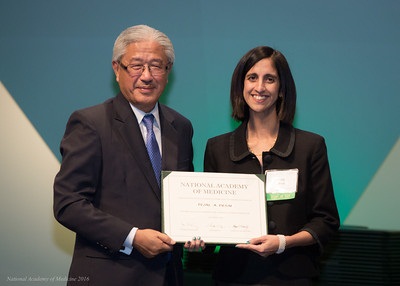
Receiving Fellowship @ NAM
One of the most interesting projects I am working on is addressing the challenges of the epithelial barrier. The epithelial barrier presents a significant obstacle to the delivery of macromolecules in the size range of 20 – 150 kDa, including a number of therapeutics. In particular, the tight junctional complex, which links adjacent cells and occludes the paracellular space, is responsible for maintaining
this barrier. To improve the transport of drugs across epithelia, new approaches need to be developed that enhance paracellular drug transport by specifically and reversibly modulating tight junctions.
My colleagues and I are investigating the effect of nanostructured surfaces on the modulation of tight junction permeability and transport of key therapeutic molecules in vitro. It is expected that the fundamental knowledge gained in these studies will enhance the development of new epithelial drug delivery systems.
The public health relevance of this work is that therapeutic macromolecular drugs currently under development are typically administered through IV injection due to their poor epithelial permeability. If we can figure out how to alter drug permeability across the epithelium in a safe and reversible manner, we can develop new delivery systems that will be less invasive and more efficacious. It may seem as though my work is all-consuming. But I assure you that you can lead a balanced and happy life.
Being a scientist does not mean you can’t have fun outside of the lab. My husband, my 3 children, and I enjoy the many wonderful recreational activities available both here in San Francisco, and
in California-at-large. We also love to travel and explore the world together. Our last adventure together was a trip to Cambodia, Singapore and Hong Kong.
I hope I will see you somewhere along the path!
Dr. Tejal Desai

Dr. Tejal Desai is currently Professor of Bioengineering and Therapeutic Sciences at the University of California, San Francisco. She is also Chair of the UCSF/UC Berkeley Graduate Group in Bioengineering, Director of the UCSF/UC Berkeley Translational Medicine Program (MTM), and a member of the California Institute for Quantitative Biomedical Research. Dr.Tejal Desai directs the Laboratory of Therapeutic Micro and Nanotechnology at UCSF.
Her research uses micro and nanofabrication techniques to create implantable biohybrid devices for cell encapsulation, drug delivery, and templates for cell and tissue regeneration. In addition to
authoring over 150 technical papers and delivering over 150 invited talks, she is the co-editor of an encyclopedia on Therapeutic Microtechnolog and a senior editor of Langmuir and Biomedical
Microdevices.
Desai’s research efforts have earned her numerous awards. She has been cited by Technology Review Magazine as one of the nation’s “Top 100 Young Innovators”, received the Global Indus Technovator Award, and named as Popular Science’s Brilliant 10. Desai’s teaching efforts were recognized when she won the College of Engineering Best Advisor/Teacher Award. She also
won the National Science Foundation’s “New Century Scholar” award and the NSF “CAREER” award, which recognizes teacher-scholars most likely to become the academic leaders of the
21st century.
Her research has also earned her the Visionary Science Award from the International Society of BioMEMS and Nanotechnology, the 2003 and 2006 Eurand Grand Prize Award for innovative drug delivery technology, the 2007 Young Career Award from the Engineering in Medicine and Biology Society (IEEE EMBS) and the UC Berkeley Distinguished Young Alumni award.